
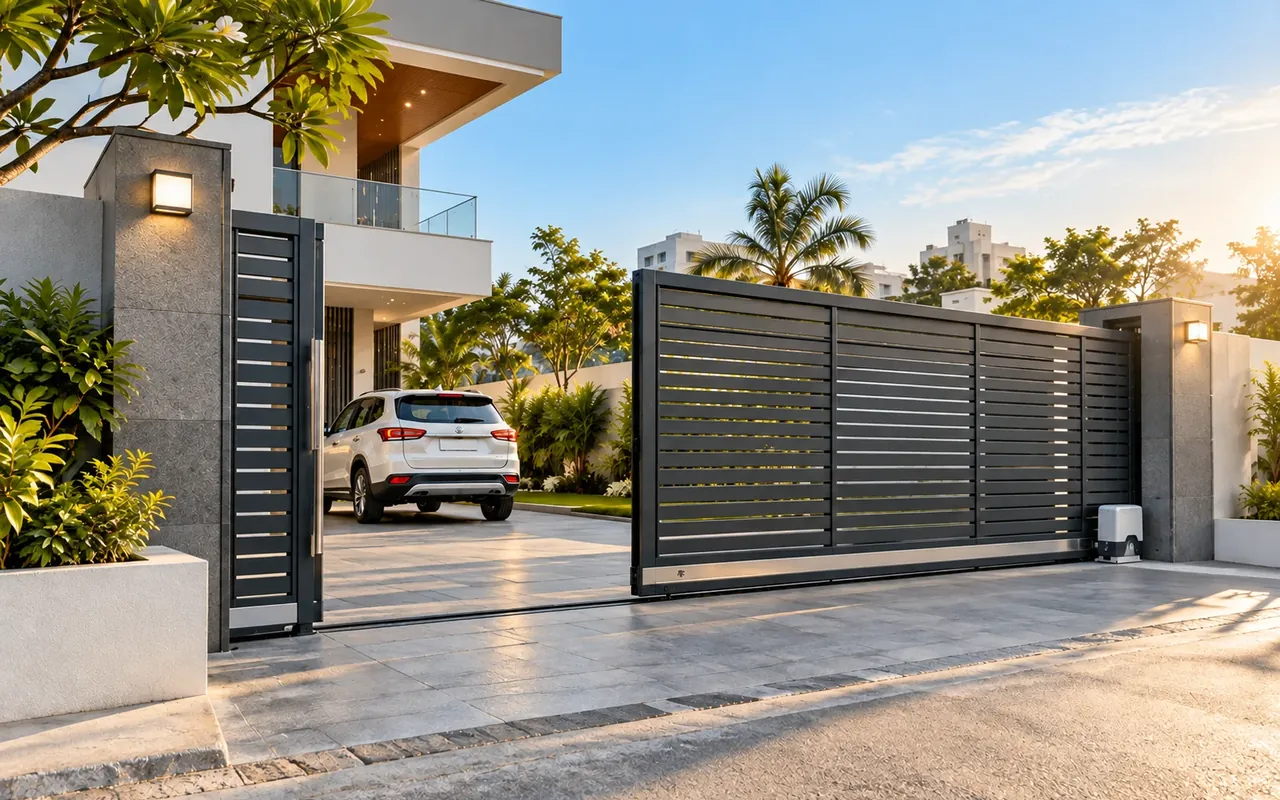
The main parts
An automatic sliding gate has four core parts: an operator (motor), a rack or chain along the gate, a control board and safety devices. The motor turns a pinion gear that meshes with the rack fixed to the gate, pushing the gate along its track or cantilever frame.
The control board receives commands from remotes, keypads, cards or a phone app, then starts and stops the motor. Limit switches or encoders tell it where the gate is.
Safety devices
Photocells send an invisible beam across the opening and stop or reverse the gate if the beam is broken. Safety edges on the gate leaf do the same on contact. A flashing lamp warns people that the gate is about to move.
What power cuts do
Most operators have a manual release so the gate can be pushed by hand. Some systems add a battery backup so the gate keeps working for a limited number of cycles. Ask which option suits your site.
Before you automate
A gate that is heavy, bent or sticks on its track will wear out any motor. A good installer checks weight, alignment, ground level and side space first and fixes the gate if needed.